

When you’re planning a renovation, it’s natural to focus on what your home needs right now.
How should the kitchen function? Where should the storage go? What finishes do you like? What will make the bathroom easier to use?
Those are all important questions. But I also believe part of our responsibility as interior designers is to look a little further ahead.
Some of the most responsible design decisions are the ones that help a home continue to work for the people living in it years from now—without requiring another major renovation because something wasn’t considered the first time.
That doesn’t mean designing every home as though someone will eventually have limited mobility. It means considering the possibilities while the walls are open and changes are relatively simple to make.
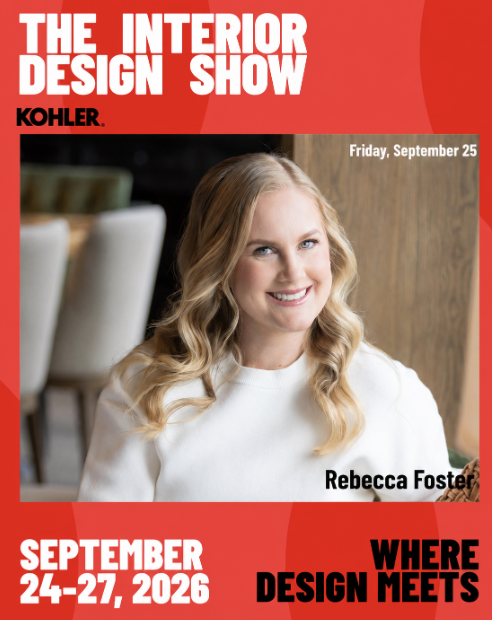
This is something I’ll be discussing at IDS Vancouver on Friday, September 25, 2026, at 11:45 a.m., where I’ve been invited to join a Kohler Canada designer panel on The Responsibility of Design.
For me, the conversation comes back to one practical question:
Are we designing this home in a way that will continue to make sense for the people who live here?
Aging in Place Is More Than an Accessibility Checklist
Aging in place gets talked about a lot in residential design, but I don’t think it should be treated as a checklist of accessibility features.
Take a curbless shower.
It can make a bathroom easier to use for someone with limited mobility, a walker or a wheelchair. But simply installing a curbless shower doesn’t suddenly make the bathroom accessible.
We also need to think about how someone gets there.
Are the doorways wide enough? Is the bathroom located on the main floor, or would someone have to navigate stairs? Is there enough room to manoeuvre inside the space? Does the circulation path through the rest of the house support the same goal?
If wheelchair access is part of the conversation, I’m looking at the entire route, not one feature in isolation.
And sometimes full wheelchair accessibility isn’t the goal at all.
The future need might simply be room for a walker. It could be the ability to install a grab bar after an injury or make daily routines easier while recovering from surgery.
Responsible design responds to the people and the home rather than adding features simply because they fall under the category of “aging in place.”
Some of the Best Future Planning Is Invisible
One of my favourite examples of future-focused design is adding backing inside bathroom walls for grab bars.
You may not need grab bars today.
You may never need them.
But if the walls are already open during a renovation, we can add the appropriate backing and document exactly where it has been installed.
Years later, if a grab bar becomes useful, it can be securely installed without opening up a finished wall again.
The same thinking can apply to electrical planning.
We might add an outlet beside the toilet even if there are no immediate plans to install a bidet seat.
For one homeowner, a bidet may simply be a comfort feature. For someone recovering from surgery or experiencing reduced mobility, it can become a very practical tool for maintaining independence.
I’ve worked with clients where features like this became genuinely helpful after a medical procedure.
That’s why future-focused design doesn’t have to feel clinical.
Often, it’s simply about creating options.
Sustainable Interior Design Is Also About Longevity
Sustainability is another important part of responsible design, but I think we sometimes make the conversation more complicated than it needs to be.
Of course, materials matter. But I’m also asking:
Where was the product made? How far does it need to travel? Can we reuse something that is already in the home? How long should the new product last? Will the homeowner still like it in ten years? And does the choice make sense within their budget?
A product marketed as sustainable isn’t automatically the most responsible choice if it stretches the homeowner’s budget beyond what is reasonable or needs to be replaced much sooner than another option.
For residential projects, one of the biggest things I consider is longevity.
I would rather specify a quality material or product that can handle everyday use for many years than choose something simply because one part of its story sounds more sustainable.
Avoiding another renovation five years from now matters too.
Timeless Interior Design Doesn’t Mean Boring
Longevity applies to the appearance of a home as well.
I’m not suggesting every renovation needs to be neutral or that homeowners should avoid personality because they’re afraid of trends.
The goal is to make sure the major, expensive-to-change elements of the home have enough staying power that you won’t feel compelled to replace them a few years later.
There’s a big difference between including something current because you genuinely love it and building an entire renovation around a short-lived trend.
Personality can come through lighting, furnishings, colour, artwork and decorative details that are easier to change over time.
But when we’re making major decisions about layouts, cabinetry, plumbing locations, flooring and architectural details, I’m thinking about how those choices are going to age.
That is part of responsible design too.
Flexible Homes Can Adapt as Life Changes
Households change.
Children grow up. Parents sometimes move in. People start working from home. Someone gets injured. A room that once had one purpose suddenly needs to do something completely different.
We can’t predict every future scenario—and trying to would make the design process exhausting.
What we can do is avoid unnecessarily limiting the home.
That might mean creating better circulation, thinking carefully about the location of rooms, providing storage that can adapt or avoiding a layout that works for only one very specific stage of life.
Responsible design isn’t about predicting the future perfectly.
It’s about leaving room for it.
The Responsibility of Interior Design Goes Beyond Aesthetics
Interior design is obviously visual. Our clients hire us because they want their homes to feel beautiful, personal and considered.
But that can’t be the only measure of a successful renovation.
As designers, we also need to think about how our decisions affect the client’s budget, how the home functions, how long the materials will last and how much flexibility the homeowners will have in the future.
A good design decision shouldn’t just photograph well when the renovation is finished.
It should continue to make sense when real life happens in the home.
Join Me at IDS Vancouver 2026
I’m looking forward to joining Madeleine Slobeck of Madeleine Design Group and Annaliesse Kelly of AK Design, with Amy Hampton-Davies of Kohler Canada moderating, for The Responsibility of Design at IDS Vancouver. You can view my speaker profile and event details here.
The panel will explore how aging populations, technology, health and wellness, urbanization, sustainability and other larger trends are changing what clients need from the spaces we design.
Friday, September 25, 2026
11:45 a.m.
IDS Vancouver
Kohler Canada is offering 20% off admission tickets, trade registrations and seminars with promo code KOHLER26.
Planning a Renovation in the Lower Mainland?
If you’re planning a renovation and want an interior design team that thinks beyond how your home will look on installation day, fill out our contact form to book a complimentary 20-minute alignment call.
We’ll talk about your project, what you need from your home now and the decisions that can help it continue working for you in the years ahead.
Looking for More Renovation Advice?
Download our free resource for practical guidance before you begin your renovation:
You can also read How to Value Engineer a Renovation Without Compromising the Entire Design to learn more about how to understand where to spend vs save during your renovation: https://aligninteriordesign.ca/how-to-value-engineer-a-renovation/
